
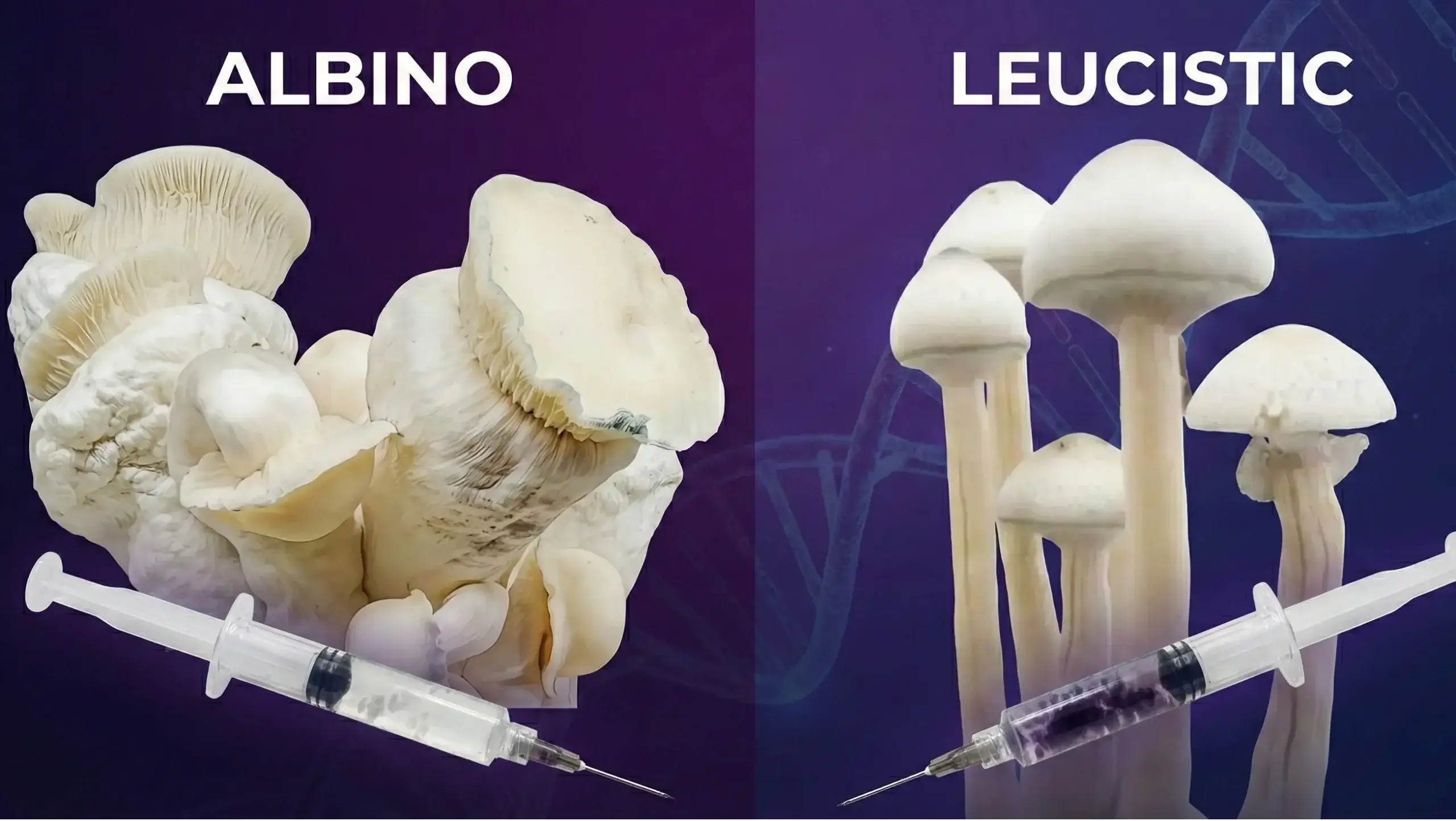
If you've ever found yourself staring at a gorgeous white mushroom strain and wondering, "Is this leucistic or albino?" you're not alone. I can't tell you how many times I've seen these terms used interchangeably in mycology forums, and honestly? The confusion makes perfect sense. Both mutations create stunningly pale specimens that catch every collector's eye, but understanding the genetic differences between them isn't just academic curiosity. It's the key to predicting everything from spore color to growing behavior.
Ready to Experience Both Types of White Genetics?
Start your journey into pale genetics with two legendary strains. Leucistic Golden Teacher offers the perfect introduction with its ghostly white caps and distinctive purple spores, while Albino Penis Envy delivers the full albino experience with completely translucent spores and pure white fruits that have made it famous worldwide.
Get Leucistic Golden Teacher Get Albino Penis EnvyWhat We'll Cover
- What Makes a Mushroom White?
- Leucistic Mutations: The Partial Loss
- True Albino Mutations: Complete Absence
- Side-by-Side Comparison
- How to Identify Each Type
- Growing Considerations
- Popular Strains Breakdown
- Frequently Asked Questions
What Makes a Mushroom White? The Genetics Primer You Actually Want to Read
Let's start with the basics, and I promise to keep this more interesting than your high school biology class. Mushrooms get their color from various pigments, with melanin being the heavyweight champion of the pigmentation world. It's the same stuff that determines human skin color, and in mushrooms, it creates those beautiful golden browns, deep purples, and rich blacks we see in spores.
Now here's where things get fascinating: both leucistic and albino mutations affect melanin production, but they do it in completely different ways. Think of it like a factory assembly line. In leucistic mushrooms, the factory is still running, but at maybe 10 to 20 percent capacity. Some pigment gets through, but not much. In true albinos? Someone's pulled the plug entirely. The factory's shut down, no melanin production whatsoever.
This is exactly what we see in strains like Jack Frost, which shows complete albinism with its signature white caps that look like they're dusted with snow. The mutation is so complete that even under microscopy, you won't find a trace of pigmentation in the spores.
The Key Genetic Difference
Leucistic mutations affect pigment distribution and partial production, while albino mutations completely block the enzymatic pathway that creates melanin. This single difference cascades into everything from spore color to UV sensitivity.
Leucistic Mutations: When Nature Hits the Dimmer Switch
Leucistic mutations are like nature's way of creating ghost versions of regular strains. The mushroom still has the genetic blueprint for making pigments, it just doesn't follow the instructions very well. This creates some absolutely stunning specimens that look like they've been bleached by moonlight.
The most telltale sign you're looking at a leucistic strain? Check those spores. Despite the pale, almost ethereal appearance of the fruiting body, leucistic strains still produce darkly pigmented spores. When you look at a spore print from a leucistic mushroom, you'll see that familiar purple-black color that lets you know the melanin production pathway isn't completely offline. Our Leucistic Golden Teacher cultivation guide dives deeper into these unique characteristics.
What makes leucistic mutations particularly interesting from a cultivation perspective is their stability. Unlike some albino strains that can be finicky about reverting or throwing off weird mutations, leucistic traits tend to breed relatively true. This makes strains like Leucistic Golden Teacher excellent choices for researchers interested in genetic work.
Common characteristics of leucistic mushrooms include:
- Pale to white caps with occasional light tan or gray undertones
- White or very pale stems that may show standard bruising
- Purple-black spores (this is crucial for identification!)
- Standard light requirements for fruiting
- Growth rates similar to their pigmented counterparts
True Albino Mutations: The Complete Genetic Knockout
True albino mushrooms are the result of a complete genetic rebellion against pigmentation. These mutations knock out the tyrosinase enzyme pathway entirely. No melanin, no backup plan, just pure white everything. And yes, that includes the spores, which is your golden ticket for identifying a true albino.
When you're working with genuinely albino strains like Albino Penis Envy (APE), Yeti 168, or the mystical Gandalf strain, you're dealing with a complete absence of melanin throughout the organism's life cycle. This creates some unique challenges and opportunities for cultivation.
Take Gandalf, for instance. This strain earned its name from its wizard-like appearance with tall, slender fruits topped with caps that look like white wizard hats. But beyond the whimsical appearance, Gandalf represents a fascinating example of stable albino genetics that maintains vigor despite the complete lack of pigmentation. Our complete Gandalf guide explores why this strain has become such a collector's favorite.
The lack of pigmentation in true albinos isn't just cosmetic. It affects how these mushrooms interact with their environment. Without melanin's protective properties, albino strains can be more sensitive to light during certain growth stages. Some cultivators swear their albinos fruit better in lower light conditions, though the research on this is still largely anecdotal.
True albino characteristics that set them apart:
- Pure white to cream-colored fruiting bodies with no color variation
- Completely translucent or clear spores
- Often slightly slower colonization (strain dependent)
- Potential increased sensitivity to environmental factors
- Unique genetic markers that can be tracked through generations
- Sometimes unusual morphology (like Jack Frost's distinctive caps)
Experience True Albino Teacher Genetics
Yeti 168 represents years of isolation work to create the perfect albino Teacher strain. This remarkable variety combines the reliability of Golden Teacher genetics with complete albinism, producing dense clusters of snow-white fruits with exceptional vigor. Unlike many albino strains that sacrifice speed for aesthetics, Yeti 168 colonizes aggressively while maintaining its stunning appearance.
Explore Yeti 168 SporesThe Ultimate Leucistic vs Albino Comparison
Let's break down the differences in a way that actually makes sense for practical application. Whether you're selecting strains for microscopy or planning your next cultivation project, understanding these distinctions helps you make informed choices.
| Characteristic | Leucistic Strains | True Albino Strains |
|---|---|---|
| Spore Color | Purple-black (pigmented) | Clear/translucent |
| Melanin Production | Reduced (10-20%) | Completely absent (0%) |
| Cap Color | White with possible tan/gray hints | Pure white to cream |
| Genetic Stability | Generally very stable | Varies by strain |
| Light Sensitivity | Normal | Potentially increased |
| Colonization Speed | Similar to parent strain | Often slightly slower |
| Identification Difficulty | Easy (check spores) | Easy (check spores) |
| Popular Examples | Leucistic Golden Teacher, Leucistic Burma | APE, Jack Frost, Yeti 168, Gandalf |
| Microscopy Interest | High (unique partial expression) | Very high (complete mutation) |
| Beginner Friendly | Yes | Strain dependent |
How to Identify Each Type: Your Visual Guide
Alright, let's get practical. You've got a white mushroom strain in front of you (or in your shopping cart), and you want to know what you're really looking at. Here's your foolproof identification guide that'll make you look like a mycology genius at your next forum discussion.
The Spore Test: Your First and Best Tool
This is the gold standard for identification, and it's surprisingly simple. If you can see the spores, whether in a syringe, on a print, or under a microscope, you've got your answer:
Quick Spore ID Guide
Dark purple/black spores = Leucistic
Clear/translucent spores = True Albino
That's it. No exceptions, no maybes. The spores don't lie.
This is how you can immediately tell that strains like Jack Frost and Yeti 168 are true albinos. Their spore syringes appear nearly clear, while leucistic varieties still show that dark purple coloration.
Visual Cues in Fruiting Bodies
Leucistic specimens often show subtle hints of their genetic heritage. Look closely at the cap, especially in natural light. You might notice:
- Faint tan or beige undertones, particularly at the cap center
- Slight color variations in different lighting
- Stems that may show normal blue bruising when handled
- Occasional "normal" colored sectors (reversion spots)
True albino specimens are more consistently white throughout:
- Uniform coloration from cap to stem
- No color variation in different lighting (except shadows)
- Pure white or cream coloration only
- Blue bruising may appear as pale blue or gray rather than deep blue
- Unique features like Jack Frost's signature "frosted" cap texture
Growing Considerations: What Actually Matters
Here's where the rubber meets the road, or should I say, where the mycelium meets the substrate? The genetic differences between leucistic and albino strains can translate into real-world cultivation considerations that might influence which type you choose for your research.
Light Requirements: Debunking the Myths
You'll hear all sorts of theories about albino mushrooms needing darkness or leucistic strains requiring special lighting. Let me save you some experimentation time: both types fruit just fine under standard lighting conditions. However, some cultivators report that true albinos like Gandalf and Jack Frost seem to produce denser flushes with slightly reduced light exposure during pinning.
The key difference isn't in what they need, but in how they respond. Without melanin's UV protection, true albinos may be more susceptible to light stress if you're using particularly intense lighting. This doesn't mean grow them in the dark. It just means your standard LED or fluorescent setup is perfectly adequate.
Colonization Patterns
In my experience and from community reports, leucistic strains tend to colonize at rates nearly identical to their pigmented parents. Leucistic Golden Teacher, for instance, shows the same reliable, moderate-speed colonization that makes regular Golden Teacher such a favorite.
True albinos can be a different story. Some, like Yeti 168, have been specifically selected for vigor and colonize aggressively. In fact, Yeti 168 is famous for colonizing faster than many pigmented strains, proving that albinism doesn't always mean slower growth. Others might take their sweet time, possibly due to the metabolic cost of completely lacking melanin. It's strain-specific rather than a universal albino trait.
Discover the Magic of Gandalf
Named for its mystical appearance and wizard-hat shaped caps, Gandalf represents one of the most visually striking albino mutations available. This strain combines complete albinism with unique morphological features, producing tall, elegant fruits that seem to glow with an otherworldly presence. Perfect for those seeking something truly extraordinary in their collection.
Get Gandalf Spore SyringesPopular Strains Breakdown: Know Your Whites
Let's get specific about some of the most sought-after leucistic and albino strains in the community. Understanding which category each falls into helps you make informed decisions about what to add to your collection.
Top Leucistic Strains
Leucistic Golden Teacher: The gateway drug of white genetics. If you want to experience leucistic traits without any cultivation surprises, this is your strain. It maintains Golden Teacher's forgiving nature while delivering those ghostly white fruits. The purple-black spores make it perfect for microscopy work where spore visibility matters. Check out our complete cultivation guide for specifics.
Leucistic Burma: Known for producing particularly dense flushes of pale fruits. The leucistic mutation seems especially stable in Burma genetics, making this a favorite for those interested in genetic work.
Leucistic Cambodian: Fast colonizer with the classic Cambodian vigor intact. The leucistic traits create an interesting contrast with the strain's typically robust growth patterns.
True Albino Powerhouses
Albino Penis Envy (APE): The heavyweight champion of albino strains. Completely lacks pigmentation throughout its lifecycle and is notorious for its unique morphology and specific cultivation requirements. APE set the standard for what albino strains could be, combining complete lack of pigmentation with the legendary Penis Envy genetics. Our APE cultivation guide covers the specific techniques that help this strain thrive.
Jack Frost: This isn't just an albino strain; it's a work of art. Jack Frost combines TAT (True Albino Teacher) and APE genetics to create something special. The caps develop a unique "frosted" appearance that looks like fresh snow, and the completely clear spores confirm its true albino status. What makes Jack Frost particularly interesting is its relatively aggressive colonization despite being a true albino. Our Jack Frost cultivation guide reveals why this strain has become a modern classic.
Yeti 168 (True Albino Teacher): This isolation represents years of careful selection work. Starting from True Albino Teacher genetics, the 168 isolation was selected for exceptional vigor and cluster formation. The result? A true albino that colonizes with surprising speed and produces dense canopies of snow-white fruits. Our Yeti 168 guide details its unique characteristics and optimal growing conditions.
Gandalf: Perhaps the most visually distinctive of all albino strains. Gandalf produces tall, slender fruits with caps that truly do look like wizard hats. The strain shows complete albinism with translucent spores, but what sets it apart is its unique growth pattern. While some albinos produce short, squat fruits, Gandalf reaches for the sky. It's become a favorite among collectors who appreciate both its aesthetic appeal and its reliable genetics.
Avery's Albino: A true albino strain that's considerably more beginner-friendly than APE. Shows complete albinism with clear spores but maintains relatively standard cubensis growth patterns. Perfect for those wanting to explore true albino genetics without the learning curve of more challenging strains.
Pro Tip: Building Your White Collection
Start with Leucistic Golden Teacher to understand leucistic traits, then move to Avery's Albino or Yeti 168 for your first true albino. Once comfortable, challenge yourself with Jack Frost or APE. Gandalf makes an excellent addition at any skill level due to its unique aesthetics and stable genetics.
Frequently Asked Questions
Are albino mushrooms more potent than leucistic ones?
There's no direct correlation between the albino or leucistic trait and potency. However, many popular albino strains like APE and Jack Frost happen to be known for their strength, which has created this misconception. The mutation affecting pigmentation is separate from alkaloid production pathways. Each strain's potency depends on its specific genetics, not its color. Yeti 168, for instance, maintains standard Teacher potency despite being a true albino.
Can you tell if a strain is leucistic or albino from a spore syringe?
Yes! This is actually the easiest way to tell. Leucistic strains will have visibly dark (purple-black) spores in the syringe, making the solution appear dark. True albino spore syringes like Jack Frost, Gandalf, or Yeti 168 will appear clear or have a very slight cloudy appearance since the spores lack pigmentation. If your "albino" spore syringe is dark, you're looking at a leucistic strain.
Which type is easier for beginners to grow?
Generally, leucistic strains are more beginner-friendly because they maintain the growth characteristics of their parent strains. Leucistic Golden Teacher, for example, is just as forgiving as regular Golden Teacher. Among true albinos, Avery's Albino and Yeti 168 are good starting points, while APE and Jack Frost may require more experience. Gandalf sits in the middle, offering unique aesthetics with moderate difficulty.
Why is Jack Frost so popular compared to other albino strains?
Jack Frost combines the best of both TAT and APE genetics, creating a true albino with distinctive "frosted" caps that look like they're covered in snow. It colonizes faster than APE while maintaining similar characteristics, making it more accessible to intermediate growers. The unique appearance and reliable genetics have made it a modern classic in the albino category.
Do leucistic and albino strains require different growing conditions?
Not significantly. Both types fruit under standard cubensis conditions. The main difference is that some true albinos may benefit from slightly reduced lighting during fruiting, though this isn't mandatory. Temperature, humidity, and fresh air requirements remain the same as their pigmented counterparts. Strains like Yeti 168 and Gandalf are particularly forgiving in this regard.
Can leucistic strains produce albino offspring?
Not directly. Leucistic and albino traits are different mutations affecting different genes. However, through selective breeding and isolation work, it's theoretically possible to develop albino expressions from leucistic parent stock if the genetic potential exists. This is how strains like Yeti 168 were developed through multiple generations of selection from Teacher genetics.
Why are true albino strains often more expensive?
True albino strains typically require more careful isolation and stabilization work to maintain their traits. The complete lack of pigmentation can make them slightly more challenging to work with in laboratory settings, and clear spores are harder to see and count for quality control. Premium strains like Jack Frost and Gandalf also represent years of selective breeding to achieve their unique characteristics.
How stable are these mutations through multiple generations?
Leucistic traits tend to be quite stable, especially in well-established strains. True albino stability varies by strain. APE and Jack Frost breed remarkably true, while others may occasionally throw off pigmented sectors or reversions. Gandalf and Yeti 168 have shown excellent stability through multiple generations, making them reliable choices for those interested in genetic work.
Conclusion: Choosing Your Path in White Genetics
Understanding the difference between leucistic and albino mushrooms isn't just about satisfying scientific curiosity. It's about making informed decisions for your mycology journey. Whether you're drawn to the stable, approachable nature of leucistic strains or the complete genetic knockout of true albinos, both offer unique opportunities for research and cultivation.
The beauty of modern mycology is that we have access to such incredible genetic diversity. From the reliable leucistic mutations that maintain their parent strains' best qualities to fascinating true albinos like Jack Frost and Gandalf that push the boundaries of what's possible in fungal genetics, there's never been a better time to explore these remarkable mutations.
Remember, the key identifier will always be those spores: dark for leucistic, clear for albino. Armed with this knowledge, you can confidently navigate the world of white genetics and choose strains that align with your research goals and experience level.
Start Your White Genetics Collection Today
Whether you're ready to explore the stability of leucistic mutations or dive into the fascinating world of true albinos, we have the perfect strain for your research. Each variety offers unique insights into fungal genetics and adaptation.
Begin with Leucistic Golden Teacher Try Jack Frost