
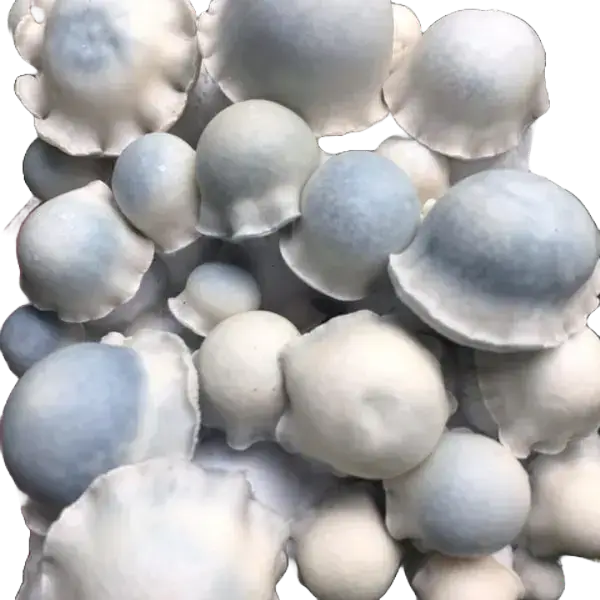
Albino Penis Envy is one of the most recognized strains in Psilocybe cubensis genetics, tracing back to Terence McKenna's original Amazonian collection. APE combines a reputation for extreme potency with a striking, ghostly white appearance that makes it instantly identifiable under the microscope. Whether you're expanding your research collection or preparing for your first APE grow, here's everything you need to know.
Add Albino Penis Envy to Your Research Collection
Our APE spore syringes feature isolated genetics prepared in our cleanroom laboratory, third-party sterility tested for reliable microscopy results every time.
Get APE Spore Syringes — $22.95What We'll Cover
- The Origin Story: McKenna, Rich Gee, and the Albino Mutation
- Visual Characteristics & Identification
- Potency & Research Profile
- Cultivation Parameters
- When to Harvest Albino Penis Envy
- APE vs Penis Envy: What's the Difference?
- How APE Compares to Other Strains
- Frequently Asked Questions
The Origin Story: From the Amazon to the Laboratory
You can't talk about Albino Penis Envy without starting at the beginning, and the beginning is a story that reads more like mycological folklore than science.
In the early 1970s, ethnobotanist Terence McKenna reportedly collected wild Psilocybe cubensis specimens from the Amazon basin. Those original spores eventually made their way to mycologist Steven Pollock, who spent years selectively isolating them for a distinctive morphological trait: a thick, bulbous stem with a small, underdeveloped cap. The result was Penis Envy, a strain so visually distinctive and potent that it immediately became the gold standard for cubensis research.
But the story doesn't end there. Enter Rich Gee, a mycologist who took Penis Envy genetics and, through careful isolation work, stabilized a leucistic mutation that produces near-complete depigmentation. The result was Albino Penis Envy: the same powerful genetics as the original PE, now wrapped in a ghostly white phenotype that drops transparent spores.
That last detail matters. Because APE produces such faint, nearly invisible spores, it's harder to propagate from spore prints than virtually any other cubensis strain. This scarcity is part of what makes quality APE genetics so sought after, and why isolated spore syringes from reputable laboratories are the standard way to acquire this strain.
Visual Characteristics & Microscopy Identification
Albino Penis Envy is one of the most visually distinctive Psilocybe cubensis strains you'll encounter. Under proper research conditions, mature specimens display:
- Caps: Small, rounded, and often underdeveloped, sometimes barely opening at all. Pure white to pale ivory coloration with occasional bluish bruising at the margins.
- Stems: Thick, dense, and bulbous, noticeably girthier than standard cubensis varieties. White throughout with aggressive blue bruising upon handling. This bruising reaction (oxidation of psilocin) is more pronounced in APE than nearly any other strain.
- Spore Print: Faint to nearly transparent. This is APE's calling card. Most cubensis strains drop dark purple-brown prints, but APE's albino genetics produce spores with virtually no pigmentation. Under the microscope, individual spores appear translucent with subtle purple-gray tinting.
- Spore Shape: Subellipsoid, 11.5–17 × 8–11 µm, consistent with the broader Penis Envy family but notable for their lack of pigmentation.
- Gills: Pale, often covered by a partial veil that doesn't fully separate from the cap, contributing to the characteristic "closed cap" appearance.
Why Mycologists Choose Albino Penis Envy
- Transparent spores : unique microscopy characteristics not found in pigmented strains
- Extreme blue oxidation : pronounced bruising reaction makes psilocin-related study immediately visible
- Genetic stability : when sourced from properly isolated genetics, APE breeds true with consistent albino expression
- Research potency : widely regarded as one of the most potent cubensis varieties in analytical studies
Potency & Research Profile
Let's address the elephant in the room: Albino Penis Envy is widely considered one of the most potent Psilocybe cubensis strains in existence. Multiple analytical studies and competition results (including Psilocybin Cup data) consistently place APE and its variants in the top tier for total tryptamine content.
While potency varies with growing conditions, substrate, and genetics, Psilocybin Cup results and independent analytical testing have shown APE typically producing psilocybin and psilocin concentrations in the range of 1.5–2× the levels found in standard cubensis strains like Golden Teacher or B+. The dense, compact morphology of APE fruits appears to concentrate active compounds more effectively than strains with larger, more water-logged fruiting bodies.
The pronounced blue bruising you'll observe when handling APE specimens isn't just cosmetic. It's a direct indicator of psilocin oxidation. The intensity of this bruising reaction correlates with alkaloid concentration, and APE's dramatic bruising is one of the reasons researchers find it so compelling for analytical study.
For researchers interested in the deeper science, the 2025 Kurzbaum et al. review in the Journal of Fungi provides an excellent overview of how genetic factors influence psilocybin biosynthesis across cubensis strains, with specific discussion of Penis Envy variants.
Cultivation Parameters
Albino Penis Envy rewards cultivators who have their sterile technique dialed in. If you're just getting started, consider working with Golden Teacher first to build your fundamentals, then move to APE once you're confident in your workflow.
APE's reputation comes from several factors: slower colonization, lower contamination resistance during early growth, and spore scarcity that makes recovery from failure more expensive. But for cultivators who can provide consistent conditions, the payoff is well worth the extra attention.
Substrate & Spawn
APE performs well on standard grain spawn (rye berries, whole oats, or millet) colonized with isolated genetics. A 1:1 spawn-to-substrate ratio is recommended for APE since the faster colonization at higher spawn rates helps offset the strain's slower growth and reduces the contamination window. For fruiting substrate, a CVG mix (coco coir, vermiculite, gypsum) at field capacity provides reliable results. Some cultivators add a small percentage of aged manure to mimic the dung-enriched environments where wild cubensis thrives, but this isn't strictly necessary with quality genetics.
Colonization Phase
Expect colonization to take 20–30% longer than standard cubensis strains. Where a Golden Teacher jar might fully colonize in 14–21 days, APE typically requires 21–30 days under identical conditions. The mycelium presents as dense and ropey (rhizomorphic) when healthy, though growth is visibly slower.
- Temperature: 75–80°F (24–27°C), consistent temperature is critical; fluctuations slow APE more than hardier strains
- Humidity: Sealed environment during colonization
- Light: Not required during colonization
- Timeline: 21–30 days to full colonization
Fruiting Conditions
APE fruits are slower to develop but produce dense, compact mushrooms with substantial biomass despite their smaller size. The strain responds well to standard fruiting conditions with a few specific considerations:
- Temperature: 70–76°F (21–24°C), slightly cooler than colonization
- Humidity: 90–95% relative humidity
- FAE (Fresh Air Exchange): 4–6 exchanges per hour. APE is somewhat less sensitive to CO2 buildup than other strains, but good air exchange still improves morphology
- Light: 12/12 cycle with indirect ambient light to trigger pinning
- Pinning timeline: 10–21 days after introducing fruiting conditions. Patience is essential
Interested in APE genetics crossed with Azurescens traits? Our Azul APE isolation pushes the boundaries of what's possible in cubensis research.
Explore Azul APE Spores — $24.95When to Harvest Albino Penis Envy
This is the question we get asked more than almost any other, and the answer for APE is different from standard cubensis strains.
With most Psilocybe cubensis varieties, you harvest just as the veil beneath the cap begins to tear away from the stem. APE breaks this rule. Because of its characteristic closed-cap morphology, many APE fruits never fully open their veils. Waiting for a traditional veil break can mean waiting forever, or worse, watching your fruits begin to degrade.
Signs APE Is Ready to Harvest
- Softening of the cap: When the cap begins to feel slightly soft and marshmallow-like to gentle touch, the fruit is at or near peak maturity
- Blue bruising intensifies: Mature APE fruits show pronounced blue coloration at the base of the stem and along the cap margins, indicating peak alkaloid concentration
- Slight color shift: The caps may develop faint golden or yellowish tinting as they approach full maturity
- Growth stalls: APE fruits reach a point where they stop gaining size but haven't opened. This plateau typically lasts 24–48 hours. Harvest during this window
- Stem firmness decreases: The stem transitions from rock-hard to having slight give when gently squeezed
The general rule: harvest APE when the fruits feel slightly soft and have stopped growing, regardless of whether the veil has broken. Waiting beyond this point risks spore drop (what little there is) and reduced potency through alkaloid degradation.
For drying, use a food dehydrator at 130–140°F (55–60°C) until cracker-dry. APE's dense morphology means it retains more moisture than thin-capped strains, so expect 8–12 hours of drying time compared to 6–8 for standard cubensis. Albino penis envy dried specimens should snap cleanly. Any flexibility indicates residual moisture.
APE vs Penis Envy: What's Actually Different?
Since both strains share the same lineage, this is one of the most common comparisons in mycology forums. Here's how they actually differ:
| Characteristic | Albino Penis Envy (APE) | Penis Envy (PE) |
|---|---|---|
| Coloration | White/ghostly, true leucistic phenotype | Golden-brown caps, white stems |
| Spore Color | Transparent/near-invisible | Dark purple-brown |
| Spore Availability | Scarce, minimal spore production | Low but visible prints possible |
| Potency | Comparable to PE, among the highest for cubensis | Among the highest for cubensis |
| Colonization Speed | Slow, 21–30 days | Slow, 18–28 days (essentially comparable) |
| Difficulty | Experienced cultivators | Intermediate to experienced |
| Morphology | Compact, dense, closed caps | Thick stems, slightly more open caps |
| Blue Bruising | Extreme, very pronounced | Strong |
The bottom line: APE is essentially the albino expression of Penis Envy genetics. The potency profile is comparable, but APE's transparent spores make it a unique specimen for microscopy research, and its scarcity adds collector value. If you want the PE experience with a striking visual twist, APE is the call.
How APE Compares to Other Popular Strains
Understanding where APE fits in the broader cubensis landscape helps you decide if it belongs in your research collection:
APE vs Golden Teacher: Night and day in terms of cultivation demands. Golden Teacher colonizes twice as fast, tolerates imperfect conditions, and produces generous flushes. APE demands precision but rewards it with dramatically higher potency and unique albino morphology. Most cultivators start with GT and graduate to APE.
APE vs Jack Frost: Jack Frost actually shares APE genetics. It's a cross between Albino Penis Envy and True Albino Teacher. Jack Frost inherited APE's white coloration but with easier cultivation requirements and faster colonization. Think of Jack Frost as APE's more approachable cousin.
APE vs Enigma: Both are high-potency strains that reward experienced growers, but Enigma doesn't produce traditional mushroom fruiting bodies at all, instead forming dense, brain-like blobs of mycelium. Enigma also doesn't produce spores, making it propagation-only via tissue culture.
For a full side-by-side of APE against a dozen other strains, check out our comprehensive strain comparison guide.
Difficulty Level: Experienced Cultivators
We consider Albino Penis Envy a strain best suited for cultivators who already have a few successful grows under their belt. Here's what to be prepared for:
- Slow colonization increases the contamination window, so your sterile technique needs to be consistent
- Lower contamination resistance than hardier strains like GT or Hillbilly
- Spore scarcity means failed grows are more costly to restart
- Non-standard harvest timing requires experience reading the signs correctly
- Longer fruiting period demands patience and consistent environmental control
None of these are dealbreakers if you've got clean technique and patience. If you're newer to cultivation and want to build those skills first, our complete cubensis strain guide can help you choose the right starting point for your experience level.
Frequently Asked Questions
Are Albino Penis Envy spores legal to purchase?
Yes. Psilocybin mushroom spores are legal to purchase, possess, and study for microscopy purposes in 47 US states. The three exceptions are California, Georgia, and Idaho, where spore possession is restricted. Spores themselves do not contain psilocybin or psilocin; these compounds are only produced during the mushroom growth process. The DEA has confirmed that spores are not a controlled substance under federal law prior to germination.
What makes Albino Penis Envy one of the most potent cubensis strains?
APE's potency is attributed to its dense, compact morphology which concentrates psilocybin and psilocin more effectively than strains with larger, more water-heavy fruiting bodies. The genetics trace back to the original Penis Envy isolation, already among the most potent cubensis varieties, with the albino mutation preserving that potency profile. Psilocybin Cup results and independent analytical testing consistently rank APE and its variants in the top tier for total tryptamine content among Psilocybe cubensis.
Why are Albino Penis Envy spores harder to find than other strains?
APE produces very few spores compared to standard cubensis strains, and those spores are nearly transparent, making traditional spore prints extremely difficult. This biological scarcity means APE genetics are primarily distributed through isolated spore syringes prepared in laboratory settings, rather than through the spore print trading that's common with other varieties. Quality isolated genetics from a reputable laboratory are the most reliable way to acquire APE.
When should you harvest Albino Penis Envy mushrooms?
Unlike most cubensis strains, APE often doesn't display a traditional veil break. Harvest when the caps feel slightly soft to gentle touch, blue bruising intensifies at the base and margins, and the fruits have stopped growing for 24–48 hours. The stem should have slight give rather than being rock-hard. Waiting for a veil break that may never come risks degradation. Dry immediately at 130–140°F until cracker-dry.
Is Albino Penis Envy a true albino or leucistic strain?
APE is technically leucistic rather than truly albino in the strict genetic sense. It exhibits dramatically reduced pigmentation rather than a complete absence of melanin. However, the mycology community has widely adopted "albino" as the standard name. True albino strains would produce completely colorless spores, while APE spores retain very faint purple-gray tinting visible under high magnification. For practical purposes, the distinction is primarily academic. APE's near-white phenotype is stable and breeds true with properly isolated genetics.
What's the difference between APE, APE Revert, and Albino Penis Envy #2?
These are all related but distinct isolations within the APE genetic family. Standard APE is the original albino mutation stabilized by Rich Gee. APE Revert (APE-R) is a sub-isolation that partially reverts to producing visible spore prints, making it easier to propagate while retaining much of APE's potency. Albino Penis Envy #2 is a separate hybrid cross (APE × PF Albino) that produces slightly different morphology. Each has its own cultivation characteristics, but standard APE remains the benchmark.
The Bottom Line on Albino Penis Envy
APE isn't the strain you start with. It's the strain you work toward. It rewards precision, patience, and genuine skill. But for researchers and cultivators who've put in the time to develop their technique, Albino Penis Envy delivers something no other cubensis strain quite matches: a combination of extreme potency, unique albino aesthetics, and microscopy characteristics that make every slide preparation a genuine discovery.
The genetics trace back through decades of dedicated mycological work, from McKenna's Amazonian collection through Pollock's isolation, Rich Gee's albino breakthrough, and the community of cultivators who've refined and preserved these genetics ever since. When you work with APE, you're working with a piece of mycology history.
Ready to Work with Albino Penis Envy Genetics?
Our APE spore syringes are prepared from isolated genetics in our cleanroom laboratory, third-party sterility tested and shipped within 24 hours.
Shop APE Spore Syringes — $22.95Further Reading
- Mushroom Strain Comparison Guide: APE vs Jack Frost, Golden Teacher & More
- Azul APE Cultivation Guide: The APE × Azurescens Hybrid
- Complete Psilocybe Cubensis Strain Guide: 18+ Varieties Compared
- Jack Frost Cultivation Guide: APE's More Approachable Cousin
- Kurzbaum et al. (2025): Exploring Psilocybe cubensis Strains: Cultivation, Compounds & Genetics