
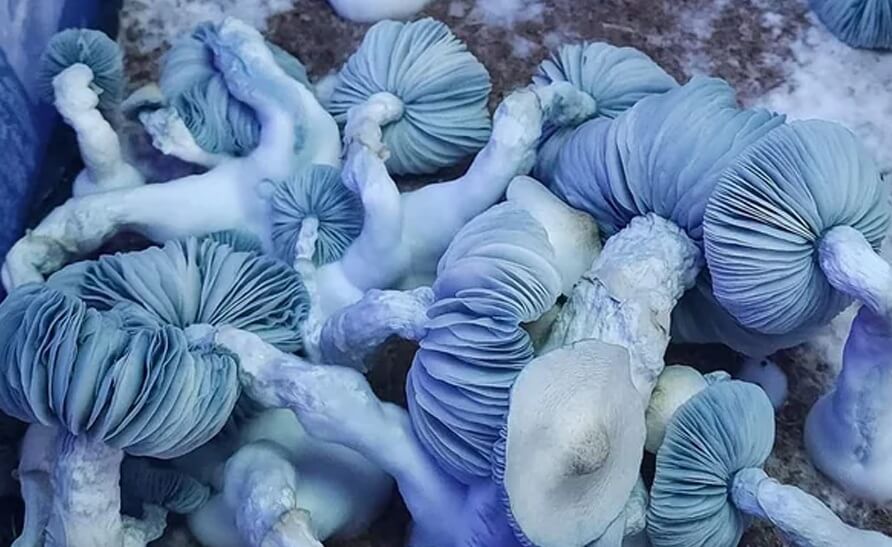
Jack Frost mushrooms look like they belong in a fairy tale. These stunning leucistic specimens produce ghostly white caps edged with delicate, curling margins that resemble frost crystals forming on a windowpane. But beautiful genetics don't always mean easy cultivation. Jack Frost demands a grower who understands albino-adjacent strains and respects the environmental precision that leucistic genetics require.
Jack Frost is a cross between True Albino Teacher (TAT) and Albino Penis Envy (APE), combining TAT's visual elegance with APE's density and potency reputation. The result is a strain that fruits prolifically, produces eye-catching canopies of pale white mushrooms, and rewards patient cultivators with impressive flushes. Unlike full albino strains that can be finicky and slow, Jack Frost carries leucistic genetics that maintain much of the visual appeal while offering significantly more forgiving cultivation characteristics.
If you're ready to work with one of the most photogenic and rewarding strains in the cubensis catalog, this guide covers everything from substrate preparation through harvest timing, with strain-specific troubleshooting to keep your grows on track.
Why Jack Frost Stands Out in the Cubensis World
Jack Frost occupies a unique position in the Psilocybe cubensis family tree. It emerged from the crossing of two already-exceptional strains: True Albino Teacher, known for its clean white aesthetics and stable genetics, and Albino Penis Envy, renowned for its density and potency. The community-driven development behind Jack Frost focused on capturing the best traits of both parents while creating something visually distinct from either one.
The strain's defining visual characteristic is its leucistic pigmentation. Where true albino strains lack pigment entirely (including in their spores), leucistic strains like Jack Frost produce reduced pigment in their fruiting bodies while still generating dark spore prints. This distinction matters for cultivators because leucistic strains tend to be more vigorous and forgiving than their fully albino counterparts, while still delivering that striking pale appearance that collectors prize.
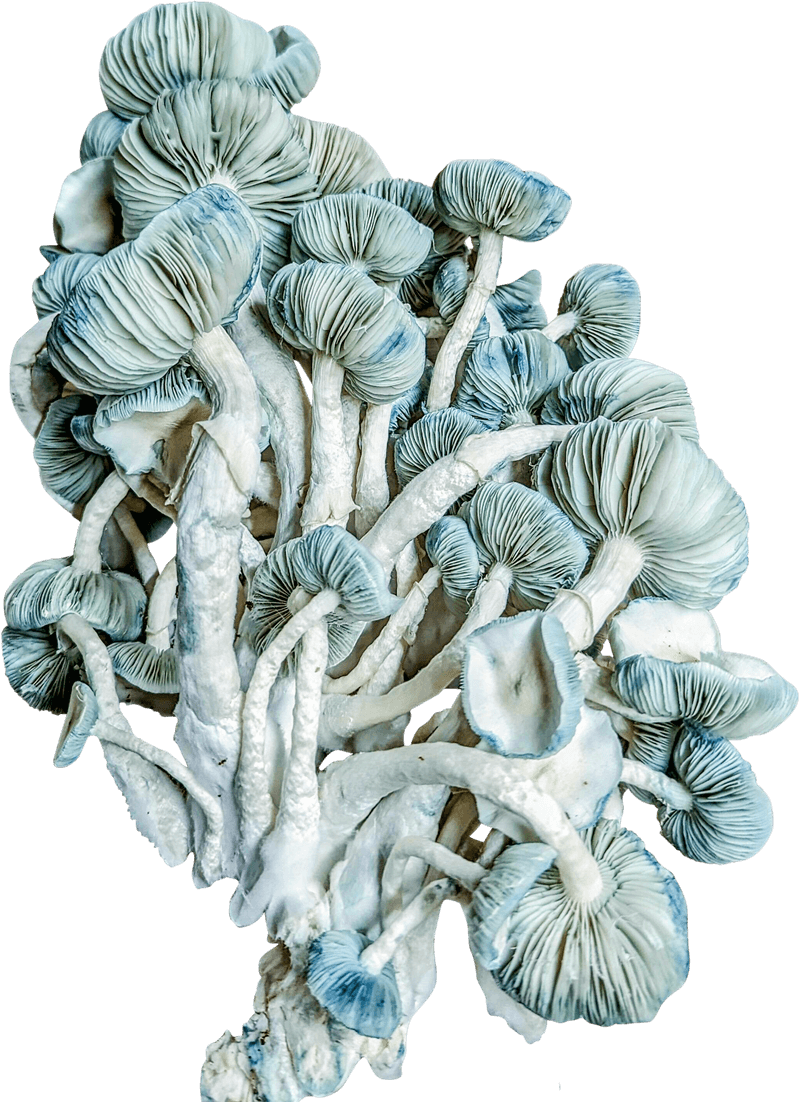
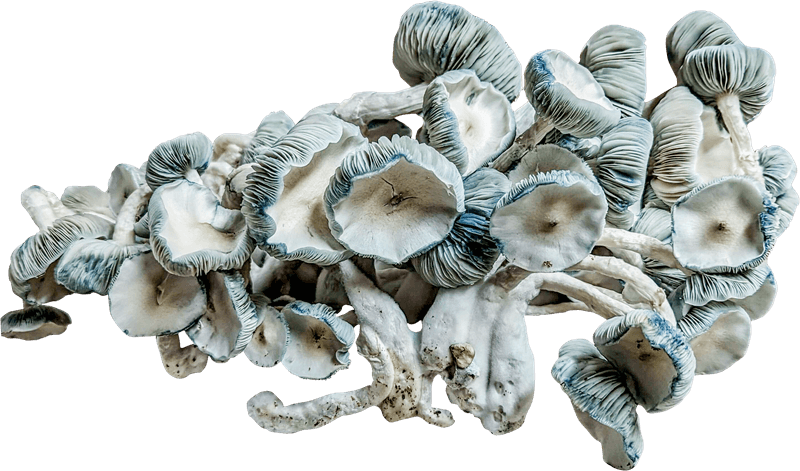
What really sets Jack Frost apart from other leucistic or albino-adjacent strains is its cap morphology. Mature specimens develop wavy, upturned cap margins that curl and fold in patterns genuinely reminiscent of frost formations. Combined with the pale white coloration, a fully mature Jack Frost canopy is one of the most visually spectacular sights in cubensis cultivation.
What Sets Jack Frost Apart From Other Strains
Leucistic Genetics: Jack Frost carries reduced-pigment genes from both parent strains, producing ghostly white fruiting bodies without the cultivation difficulties associated with true albino genetics. Spore prints remain dark, making propagation straightforward.
Dual-Lineage Potency: As a TAT x APE cross, Jack Frost inherits potency characteristics from the Penis Envy lineage while maintaining the cultivation reliability of the Teacher line. Published analytical data places cubensis strains in this lineage above average for total tryptamine content (Kurzbaum et al., 2025).
Distinctive Cap Morphology: The signature curling, frost-like cap margins develop during the final stages of maturation. No other cubensis strain produces this exact combination of white coloration and ornamental cap structure.
Aggressive Colonization: Despite its exotic appearance, Jack Frost colonizes grain spawn at speeds comparable to standard cubensis strains, typically completing colonization in 10 to 14 days under optimal conditions. This sets it apart from slower albino varieties like Azul APE, which can take 50% longer.
Essential Equipment and Substrate Preparation
Jack Frost performs well on the same substrates and equipment used for standard cubensis cultivation, but a few strain-specific considerations will improve your results significantly. Because leucistic strains show contamination less obviously than pigmented varieties (green mold against a white substrate and white mycelium can be tricky to spot early), your sterile technique needs to be airtight from the start.
For grain spawn, a rye, milo, and millet mix provides an excellent nutritional foundation and fast colonization. Jack Frost mycelium is rhizomorphic and aggressive on grain, often showing visible growth within 3 to 5 days of inoculation. Whole oats and rye berries also work well. Avoid popcorn tek for this strain as the larger kernel size can create air pockets that slow colonization.
For bulk substrate, CVG (coir, vermiculite, gypsum) at field capacity is the standard and works perfectly for Jack Frost. A ratio of 650g coir, 2 quarts vermiculite, and 1 cup gypsum hydrated with approximately 16 cups of boiling water produces a substrate with the right moisture content and structure. Some growers report improved yields by adding a small amount of aged hardwood fuel pellets (10 to 15% of total substrate volume), though straight CVG produces excellent results on its own.
Critical Equipment for Jack Frost Cultivation
Still Air Box or Flow Hood: Non-negotiable for Jack Frost. Leucistic mycelium makes early contamination detection harder, so preventing contamination at the source is your best strategy. A SAB is sufficient for hobby-scale work; a laminar flow hood is ideal for anyone running multiple tubs.
Grain Spawn Jars or Bags: Quart jars with modified lids or unicorn bags with 0.2 micron filter patches. Jack Frost colonizes aggressively, so standard gas exchange is sufficient. No need for extra filter patches or injection ports beyond what you'd use for any cubensis strain.
Monotub or Shoebox Containers: 54 to 66 quart monotubs for full-scale grows, or 6 quart shoeboxes for smaller experimental runs. Jack Frost fruits beautifully in both formats. Shoeboxes are excellent for dialing in conditions before committing to a full monotub.
Reliable Thermometer and Hygrometer: Leucistic strains can be slightly more sensitive to temperature swings during fruiting than pigmented varieties. A digital thermometer/hygrometer combo placed inside your fruiting chamber eliminates guesswork.
The Jack Frost Inoculation Process: Setting the Foundation
Jack Frost liquid culture inoculation follows standard cubensis protocol with one important advantage: the strain's aggressive mycelium means you'll see results faster than with most albino-lineage strains. Where a full albino variety might leave you staring at unchanged grain for a week or more, Jack Frost typically shows visible colonization within 3 to 5 days.
Start with a clean workspace. Wipe down your SAB interior with 70% isopropyl alcohol. Flame-sterilize your needle until it glows red, let it cool for 10 seconds, and inject 1 to 2cc of Jack Frost liquid culture into each jar or bag. For grain jars, inject against the glass so you can monitor colonization progress visually. For bags, inject near the top and distribute the liquid culture across the grain surface.
After inoculation, store your grain at 75 to 80°F in a dark location with minimal disturbance. Jack Frost mycelium is rhizomorphic, meaning it grows in thick, ropy strands that indicate healthy and vigorous genetics. If you see wispy, cottony growth instead, your temperatures may be too high or your grain moisture content may need adjustment.
Expect full colonization in 10 to 14 days for quart jars inoculated with liquid culture. Once the grain is 100% colonized with no uncolonized kernels visible, shake the jar vigorously to redistribute the mycelium, then wait an additional 3 to 5 days for the grain to reconsolidate before spawning to bulk substrate. This break-and-shake step isn't strictly necessary with Jack Frost's aggressive colonization, but it produces more even bulk colonization and reduces the chance of contaminant pockets hiding in the center of the jar.
Jack Frost Inoculation Best Practices
Liquid Culture Advantage: Jack Frost liquid culture provides a significant head start over spore syringes. Live mycelium in liquid culture begins colonizing immediately upon contact with grain, cutting total colonization time by 30 to 50% compared to spore germination.
Inoculation Volume: Use 1 to 2cc per quart jar. More isn't better. Excess liquid culture adds unnecessary moisture to your grain, increasing the risk of wet rot and bacterial contamination.
Temperature Consistency: Maintain 75 to 80°F throughout colonization. Jack Frost is tolerant of minor fluctuations, but sustained temperatures above 82°F can promote bacterial growth that competes with mycelium.
Patience With the Shake: Wait for 100% visible colonization before shaking. Shaking a partially colonized jar exposes uncolonized grain to potential contaminants that the mycelium hasn't yet defended against.
Want to compare Jack Frost with other premium albino strains? Explore our complete strain profiles for detailed side-by-side comparisons and insights.
Mastering Jack Frost Fruiting Conditions
Jack Frost's fruiting requirements are where the strain truly distinguishes itself from standard cubensis varieties. While the basic parameters fall within normal cubensis range, the margins for optimal results are tighter than with something like Golden Teacher or Hillbilly. Getting these conditions right is the difference between a mediocre canopy of small, underdeveloped fruits and a spectacular flush of large, properly formed specimens with those signature frosted cap margins.
After spawning to bulk substrate at a 1:2 to 1:3 spawn-to-substrate ratio, seal your tub and allow colonization to proceed for 7 to 10 days. Jack Frost colonizes bulk substrate slightly faster than average, and you'll notice the surface turning completely white with a thick mycelial mat. When the entire surface is colonized and you begin to see small hyphal knots forming (tiny bumps of dense mycelium), it's time to introduce fruiting conditions.
Crack your tub lids to allow fresh air exchange, or open your monotub's air holes. Increase ambient light to a 12/12 cycle using indirect natural light or a simple LED strip on a timer. The light doesn't need to be intense; Jack Frost responds to even low light levels as a pinning trigger. Maintain humidity by misting the sides and lid of your tub rather than misting the substrate surface directly. Direct misting on leucistic pins can promote bacterial blotch, which shows as yellowish discoloration on the white caps.
Jack Frost pins generously. A well-prepared tub will produce a dense, even pinset across the entire surface within 5 to 7 days of introducing fruiting conditions. The pins emerge as tiny white dots that develop rapidly into recognizable mushroom primordia. From first pins to harvest-ready fruits typically takes 7 to 10 days, depending on temperature and humidity.
Jack Frost-Specific Fruiting Parameters
Temperature: 70 to 75°F is the sweet spot for Jack Frost. This is slightly cooler than the standard cubensis range of 72 to 78°F. The cooler temperatures produce denser fruits with better-developed cap morphology, including those distinctive curling margins. Temperatures above 78°F tend to produce thinner stems and less dramatic cap features.
Humidity: 90 to 95% relative humidity during pinning, gradually reducing to 85 to 90% as fruits develop. Jack Frost is somewhat less tolerant of low humidity than pigmented strains. If caps begin cracking or splitting, your humidity has dropped too low.
Fresh Air Exchange: Moderate FAE is critical. Jack Frost is sensitive to CO2 buildup, which causes elongated stems and small, underdeveloped caps ("fuzzy feet" at the base of stems is an early warning sign). If you see fuzzy feet, increase FAE immediately.
Lighting: 12 hours on, 12 hours off using indirect or ambient light. Jack Frost doesn't require strong light, but consistent light cycling improves pinset uniformity and cap development.
Harvesting Jack Frost: Timing Is Everything
Harvest timing with Jack Frost requires more attention than with standard pigmented strains because the visual cues are different. With a typical cubensis strain, you watch for the veil beneath the cap to stretch and begin tearing away from the stem. Jack Frost follows the same biological process, but the reduced pigmentation makes the veil less visually obvious against the white stem and cap.
The best harvest window for Jack Frost is when the caps have fully expanded and begun to flatten or upturn, but before the veil has completely torn and dropped spores. On leucistic fruits, look for the cap margin beginning to curl upward and outward, revealing the gills beneath. The gills will appear pale gray to light lavender before spore release, darkening to purple-black as spores mature. Harvesting just as the gills transition from pale to lavender captures peak potency and produces the cleanest-looking dried specimens.
To harvest, grip the base of each mushroom firmly and twist gently while pulling upward. Jack Frost stems are dense and sturdy, so they twist cleanly from the substrate without tearing the mycelial mat. Avoid cutting with a knife if possible, as the remaining stem stump can become a contamination entry point between flushes. After harvesting, clean any substrate debris from the base of each mushroom before drying.
Jack Frost produces 3 to 5 productive flushes from a single tub. After each harvest, soak the substrate block in cold water for 6 to 12 hours to rehydrate, then drain and return to fruiting conditions. Second and third flushes often produce fewer but larger individual fruits, and the characteristic cap curling becomes more pronounced in later flushes.
Jack Frost Harvest Indicators
Cap Margin Curling: The signature Jack Frost frost-like cap edges develop during the final 24 to 48 hours before harvest. When the caps begin curling upward and the edges become wavy and ornamental, you're in the harvest window.
Veil Stretching: Look closely at the junction between cap and stem. On white fruits, the veil appears as a thin, slightly translucent membrane. When this membrane begins to stretch and thin, harvest within 6 to 12 hours.
Gill Color Shift: Gills transition from white to pale lavender as spores mature. Harvest at the lavender stage for optimal timing. If gills appear dark purple, you've waited slightly too long, but the fruits are still perfectly usable.
Stem Firmness: Mature Jack Frost stems feel solid and dense when gently squeezed. If stems feel hollow or spongy, the fruits may be dehydrated from low humidity or past their peak.
Troubleshooting Common Jack Frost Growing Problems
Yellowing or Discoloration on White Caps (Most Common Issue)
Yellow spots or patches on Jack Frost caps are almost always bacterial blotch caused by excess surface moisture. Because the fruits are white, even minor bacterial contamination that would be invisible on a pigmented strain becomes glaringly obvious. This is cosmetic in mild cases but can reduce yields if severe.
Solution: Stop misting the substrate surface directly. Instead, mist the walls and lid of your tub and allow humidity to distribute evenly through evaporation. Increase fresh air exchange slightly to reduce standing moisture on cap surfaces. If bacterial blotch is already present on developing fruits, increase FAE and reduce misting frequency. Affected fruits are still safe to harvest; simply trim any severely discolored areas during processing.
Fuzzy Feet and Elongated Stems
Thick white fuzz at the base of Jack Frost stems indicates excessive CO2 levels in your fruiting chamber. Stems growing disproportionately tall with small caps is a related symptom. Both issues point to insufficient fresh air exchange.
Solution: Increase FAE by opening tub lids wider, adding additional air holes, or using a small computer fan on a timer to circulate air. For monotubs, ensure your air exchange holes are not blocked by micropore tape that's become wet and sealed. Fuzzy feet won't damage existing fruits, but correcting the issue early in a flush produces dramatically better cap development in the remaining pins.
Slow or Uneven Pinning
Jack Frost typically produces dense, even pinsets, so patchy or delayed pinning usually indicates a surface conditions problem rather than a genetic issue. The most common causes are substrate surface drying, uneven colonization, or insufficient light triggering.
Solution: Ensure the substrate surface maintains a consistent layer of fine water droplets (referred to as "surface conditions"). These tiny droplets should look like morning dew on grass. If the surface appears dry, lightly mist from 12+ inches above the tub and fan gently. If colonization was uneven, give the tub an additional 2 to 3 days before introducing fruiting conditions. Confirm your light source is providing consistent 12/12 cycling.
Contamination Detection Challenges
The most frustrating challenge unique to leucistic strains like Jack Frost is contamination camouflage. Green mold (Trichoderma) in its early white stage looks identical to Jack Frost mycelium. By the time it turns green and becomes obvious, it has already sporulated and compromised your tub.
Solution: Learn to identify contaminants by texture and growth pattern rather than color alone. Healthy Jack Frost mycelium grows in thick, ropy rhizomorphic strands. Trichoderma appears as fluffy, cotton-like patches that grow rapidly and lack the ropy texture of healthy mycelium. If you suspect contamination, isolate the tub immediately and observe for 24 hours. Any patch that develops green coloration confirms Trichoderma and the tub should be removed from your growing area.
Ready to start your Jack Frost growing journey? Browse our full selection of premium spore syringes and liquid cultures and find your perfect strain.
Advanced Jack Frost Cultivation Techniques
Once you've successfully fruited Jack Frost using standard monotub technique, several advanced approaches can push your yields and specimen quality further.
Temperature manipulation during fruiting produces noticeable improvements in Jack Frost's signature cap morphology. Dropping nighttime temperatures to 65 to 68°F while maintaining daytime temperatures of 72 to 75°F simulates natural diurnal cycling and produces denser fruits with more pronounced cap curling. This temperature swing also tends to trigger more uniform pinsets, as the mycelium responds to the environmental cycling as a fruiting signal.
For growers interested in maximizing yields across multiple flushes, cold shocking between flushes can improve later flush productivity. After harvesting and soaking the substrate block, place the sealed tub in a refrigerator at 38 to 42°F for 12 to 24 hours before returning to fruiting conditions. This cold shock mimics seasonal temperature drops that trigger fruiting in wild Psilocybe species and can significantly improve third, fourth, and fifth flush production.
Agar work with Jack Frost isolates is straightforward and rewarding. The leucistic phenotype is genetically stable, so transfers from quality specimens reliably produce offspring with the same visual characteristics. Isolating from your best-performing fruits (largest size, most dramatic cap morphology, fastest growth) across 3 to 4 agar transfers can produce a stabilized culture line that consistently outperforms multispore or even liquid culture genetics.
Comparing Jack Frost to Other Premium Albino Strains
Jack Frost sits in a competitive category alongside several other albino and leucistic strains, each with distinct advantages depending on your priorities as a cultivator.
Compared to Azul APE, Jack Frost is significantly more approachable. Azul APE inherits the full difficulty profile of its Albino Penis Envy parent: slower colonization (often 3 to 4 weeks on grain), pickier fruiting conditions, and a tendency toward overlay if surface conditions aren't dialed in. Jack Frost colonizes faster, pins more readily, and forgives minor environmental fluctuations that would stall an APE grow. Where Azul APE wins is in density and potency reputation, as the Penis Envy genetics produce thick, compact fruits with higher tryptamine concentrations per gram of dried weight. For beginners working with albino-lineage strains for the first time, Jack Frost is the clear starting point.
Against Albino Bluey Vuitton, Jack Frost offers a different kind of visual appeal. ABV produces squat, dense fruits with a smooth white appearance, while Jack Frost grows taller with those ornamental curling caps. Cultivation difficulty is similar between the two, though ABV tends to produce slightly smaller individual fruits in exchange for denser pinsets. Both are excellent choices for growers who want albino aesthetics without the extreme difficulty of full APE genetics. The deciding factor often comes down to visual preference: ABV's compact, designer-look specimens versus Jack Frost's dramatic, frost-tipped canopies.
For cultivators who want to explore the full range of albino cubensis genetics, starting with Jack Frost, progressing to Albino Bluey Vuitton, and eventually tackling Azul APE provides a natural difficulty progression that builds skills incrementally.
Storage and Preservation of Jack Frost Mushrooms
Proper drying and storage is critical for preserving Jack Frost's quality after harvest. Because the fruits are white, any discoloration from improper drying becomes immediately visible, so technique matters both functionally and aesthetically.
Use a food dehydrator set to 130 to 140°F and dry until specimens are completely cracker-dry. This means they snap cleanly when bent rather than bending or flexing. Jack Frost's dense stems can retain moisture in the center even when the exterior feels dry, so err on the side of longer drying times. A typical batch takes 8 to 12 hours in a dehydrator, though particularly thick stems may need up to 16 hours.
Once fully dried, store in airtight glass jars with food-grade desiccant packets. Mason jars with tight-fitting lids work perfectly. Store in a cool, dark location away from direct sunlight. UV exposure degrades active compounds over time and can cause yellowing of the white flesh, reducing both potency and visual appeal. Properly dried and stored Jack Frost specimens maintain their quality for 12 months or longer.
For long-term storage beyond 12 months, vacuum sealing dried specimens in individual dose portions with desiccant provides the best preservation. Frozen storage in vacuum-sealed bags extends shelf life even further, though freezing is only appropriate for specimens that are already completely cracker-dry. Any residual moisture will cause ice crystal damage that degrades the material.
Ready to Start Your Jack Frost Growing Journey?
Jack Frost rewards growers who appreciate both beauty and performance. With the right technique, you'll be harvesting stunning white canopies that showcase some of the most striking genetics in the cubensis world.
Get Jack Frost Liquid Culture NowFinal Thoughts: Why Jack Frost Belongs in Every Collection
Jack Frost occupies a rare sweet spot in cubensis cultivation. It delivers the visual impact of albino genetics without the steep learning curve that discourages many growers from attempting strains like APE or its variants. The leucistic phenotype produces genuinely spectacular specimens, the colonization speed keeps projects moving, and the forgiving nature of the genetics means your first grow has a real chance of success.
The key takeaways for Jack Frost success are straightforward: maintain cooler fruiting temperatures (70 to 75°F) for the best cap development, keep humidity high without misting caps directly, prioritize FAE to avoid elongated stems, and learn to read harvest cues from gill color rather than relying on veil visibility alone. Master those four variables and Jack Frost will consistently produce some of the most beautiful flushes you've ever grown.
Whether you're adding your first albino-lineage strain to an established collection or building a new growing setup around a visually stunning variety, Jack Frost liquid culture is an outstanding place to start.
Continue Your Mycology Journey
- Azul APE Liquid Culture Syringe - The next step in albino-lineage difficulty for experienced growers
- Albino Bluey Vuitton Liquid Culture Syringe - A complementary albino strain with squat, dense morphology
- Complete Strain Profiles - Side-by-side comparisons to help you choose your next grow
- Enigma, APE & Golden Teacher Bundle - Three distinct genetic expressions in one collection
- Full Liquid Culture Catalog - Browse every strain in the Atlas Spores library
References
- Kurzbaum E. et al. (2025). "Exploring Psilocybe cubensis Strains: Cultivation Techniques, Psychoactive Compounds, Genetics and Research Gaps." PMC/NIH.
- Cohen J. et al. (2025). "Comprehensive analysis of 42 psilocybin-producing fungal strains." Nature Scientific Reports.
- Goff R. et al. (2024). "Determination of psilocybin and psilocin content in multiple strains of Psilocybe cubensis." Analytical Chemistry.
- Beckley Foundation (2025). "Types of Psychedelic Mushrooms: A Species Guide."