
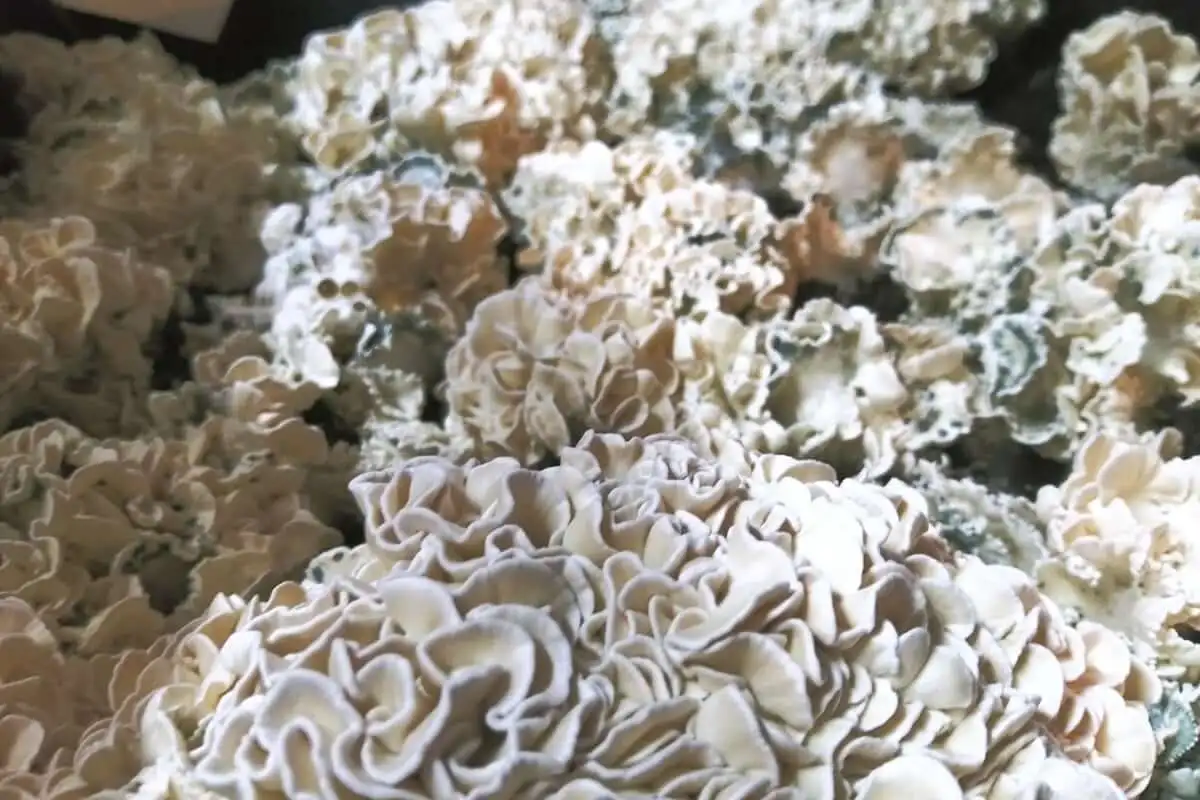
The Enigma mushroom strain is a sterile, non-sporulating mutation of Psilocybe cubensis that grows as dense, brain-like or coral-like tissue formations instead of traditional caps and stems. It emerged from Tidal Wave genetics (a Penis Envy × B+ hybrid) and can only be propagated through tissue cloning, making every sample genetically identical. Among cubensis varieties, Enigma stands in a category of its own: a morphological anomaly with some of the highest documented psilocybin concentrations in the species.
If you’ve spent any time in mycology communities, you’ve probably heard the name spoken with a certain reverence. Enigma cubensis doesn’t just look different. It is different, right down to the cellular level. Where standard cubensis strains follow a predictable arc from primordium to pinning to a classic capped mushroom, Enigma just keeps growing, folding in on itself, accumulating dense tissue in ways that challenge everything we expect from this species.
Whether you’re a researcher drawn to its unusual morphology, a microscopist looking to study something genuinely unique, or a cultivator ready to take on something beyond the standard playbook, this guide covers everything you need to know about the Enigma strain: its origins, its biology, what makes it so interesting under a microscope, and how to grow it successfully. Let’s get into it.
Ready to add Enigma to your research collection? Explore our Enigma isolated spore syringe or browse our full strain profiles to compare it with other premium cubensis varieties.
The Origins of the Enigma Mushroom Strain
The story behind Enigma cubensis is almost as unusual as the mushroom itself. Enigma emerged as a spontaneous mutation from a Tidal Wave grow. Tidal Wave was a deliberate cross between Penis Envy and B+, developed by mycologist Doma (known online as Magic Myco), who established the Tidal Wave genetics around 2017. Penis Envy brought dense, high-alkaloid tissue to the lineage; B+ contributed vigorous growth and environmental adaptability. Tidal Wave quickly earned a reputation for instability, and out of that instability came something remarkable.
The mutation was first recognized by community grower “Boomer,” who noticed the coral-like formations emerging from a Tidal Wave substrate and understood immediately that he was looking at something new. Photos spread through Shroomery, Facebook, and Instagram, sparking both fascination and debate. Doma’s side of the story positioned the same genetics as “Tidal Wave 2,” while the community rallied around the name Enigma. For years, the mycology community upheld an informal ethic around it: Enigma could only be gifted, not sold, a nod to the strain’s community-first origins that held until around 2022, when it became more widely available through spore vendors.
What makes the origin story particularly interesting from a research perspective is what triggered the mutation. The leading hypothesis is that Enigma represents a developmental arrest: a failure of the primordial tissue to differentiate into the structures needed for spore reproduction. The result is a genetically stable, completely sterile culture that has survived for years solely because humans continue to clone and share it. In nature, it would be an evolutionary dead end. In the lab, it’s one of the most studied cubensis anomalies in the hobbyist mycology world.
Enigma Strain: Key Facts at a Glance
Species: Psilocybe cubensis (mutation)
Genetic Lineage: Emerged from Tidal Wave (Penis Envy × B+ cross)
First Isolated: Community-attributed to Boomer/Magic Myco; widely shared circa 2020–2022
Morphology: Dense, brain-like or coral-like tissue blobs; no caps, stems, gills, or basidia
Spore Production: None. Completely sterile; propagation by tissue cloning only
Documented Potency: 2.0–3.8% total tryptamines (among the highest recorded for cubensis)
Also Known As: Tidal Wave 2, Brainiac, Enigma cubensis
What Makes Enigma Cubensis Morphologically Unique
Standard Psilocybe cubensis follows a predictable developmental sequence: the mycelium forms primordia, which differentiate within 24–48 hours into the familiar cap-and-stem structure. Gills develop on the underside of the cap to support basidiospore production. The whole system is optimized for reproduction. Enigma bypasses all of that.
Instead of differentiating, Enigma primordia remain in a state of continuous undifferentiated growth. The cells keep dividing without forming the specialized reproductive structures: no gills, no basidia, no spores. What you get instead are dense, folded tissue masses that can reach the size of a baseball or larger when given enough time. The surface is irregular and deeply furrowed, resembling brain coral or a cauliflower head more than anything we’d normally call a mushroom.
This morphology isn’t just visually striking. It has measurable consequences for tissue density and alkaloid concentration. Because Enigma isn’t directing energy toward spore production, that metabolic output appears to redirect into tissue accumulation. The formations are significantly denser than standard cubensis fruiting bodies, which is one reason researchers and cultivators consistently report alkaloid concentrations well above typical cubensis ranges.
Enigma Morphology vs. Standard Cubensis
Growth Form: Dense, brain-like or coral-like blobs vs. traditional cap-and-stem fruiting bodies
Surface Texture: Deeply furrowed, irregular folds vs. smooth or fibrous cap surface
Gills: Absent in Enigma vs. present and spore-bearing in standard strains
Bruising: Intense blue bruising across all tissue surfaces, a reliable visual characteristic
Color: Cream to light tan, with blue-tinged fin edges as formations mature
Size: Single formations commonly reach 50–200g fresh weight
Spores: Not produced. Tissue cloning is the only propagation method
Why Enigma Doesn’t Produce Spores, and Why That Matters
The sterility of Enigma cubensis is its most scientifically interesting characteristic. To understand why, it helps to know what spore production actually requires. In standard cubensis, mature primordia differentiate into a cap (pileus) lined with gills (lamellae). On those gill surfaces, specialized cells called basidia produce four spores each, the primary means of genetic recombination and dispersal for the species.
Enigma lacks the genetic programming to form any of those structures. The mutation interrupts fruiting body development before differentiation begins, leaving the tissue in a perpetual proliferative state. No cap forms, so no gills develop, so no basidia are produced, so no spores are ever released. The mutation appears to be genetically stable. Enigma has maintained this phenotype consistently across years of transfers and cloning by hundreds of cultivators worldwide.
From a mycological research standpoint, this raises genuinely interesting questions. The sterility suggests a disruption in the signaling pathways that regulate developmental differentiation in cubensis, possibly related to the mechanisms that govern how fungal cells “decide” to become specialized tissue. Published research in peer-reviewed journals has identified Enigma as a recognized cubensis anomaly worthy of formal scientific documentation, though detailed molecular studies of the mutation remain limited due to the strain’s unusual history.
For propagation purposes, the practical consequence is straightforward: you can’t grow Enigma from a spore print or standard spore syringe in the way you would with any other cubensis strain. Every sample in circulation today traces back to tissue cloning, which is also why isolated Enigma genetics represent a genuinely rare and specific product offering.
Looking to compare Enigma with other high-interest cubensis varieties? Our mushroom strain comparison guide breaks down the key differences across potency, morphology, and research characteristics.
Studying Enigma Spores Under the Microscope
Because Enigma is sterile, traditional spore microscopy (examining spore prints under magnification) isn’t applicable to this strain the way it is with standard cubensis. What researchers and microscopists study instead is the vegetative mycelium and tissue structure, along with hyphal morphology and the unusual cellular arrangement that defines the blob phenotype.
Under compound microscopy, Enigma mycelium presents the typical cubensis hyphal network (septate, branching hyphae with clamp connections) but the undifferentiated tissue of the fruiting formations reveals something more unusual: a dense, tightly packed cellular mass without the organized lamella or hymenium structures you’d see in a normal cubensis fruiting body. The absence of basidial cells and the compressed, irregular arrangement of the tissue are the defining microscopic features that distinguish Enigma from any other cubensis variety.
For anyone working with an Enigma isolated spore syringe, the microscopy preparation follows the same fundamental approach as other cubensis strains at the vegetative stage. Clean technique, appropriate magnification (400x–1000x for hyphal detail), and quality optics are all that’s needed to begin observing what makes this mutation structurally distinct.
What to Look For When Studying Enigma Under Microscopy
Hyphal morphology: Septate hyphae with visible clamp connections, consistent with Psilocybe cubensis
Tissue organization: Dense, undifferentiated cellular mass in fruiting tissue; no organized gill or hymenium structures
Bruising indicator: Blue oxidation (psilocin conversion) is visible even at low magnification when tissue is disturbed
Recommended magnification: 400x for general structure; 1000x (oil immersion) for hyphal and cellular detail
Slide preparation: Wet mount from fresh tissue sample or germinating mycelium; standard water or KOH mounting medium
Essential Equipment and Substrate Preparation
Enigma cultivation doesn’t require exotic equipment. What it requires is reliability. Because the grow runs 10–14 weeks instead of the typical 6–8, every variable that could introduce contamination or environmental stress has more time to cause problems. Your setup doesn’t need to be elaborate, but it does need to be consistent.
Core Equipment for Enigma Cultivation
Fruiting chamber: A standard monotub works well with minor modifications: reduce FAE holes or partially cover them to maintain higher humidity than a normal cubensis grow. Enigma prefers a more still, humid environment during blob formation.
Spawn: Sterilized grain (rye, wheat berries, or oats) at a 25–30% spawn-to-substrate ratio. The higher spawn ratio gives Enigma mycelium a competitive edge against contamination over the extended timeline.
Substrate: CVG (coir, vermiculite, gypsum) is the standard and performs well. An optional 10% amendment of brown rice flour or wheat bran provides additional nutritional support for the longer fruiting period.
Humidity management: A simple spray bottle is sufficient. Enigma doesn’t need automated misting, just consistent attention to moisture levels throughout the grow.
The Inoculation Process: Setting Up for Success
Enigma inoculation follows the same sterile workflow as any cubensis strain. The difference isn’t in technique. It’s in mindset. Because you’re setting up a 14-week commitment rather than a 6-week one, your initial preparation matters more. A contaminated substrate discovered at week 10 is a much more frustrating outcome than one spotted at week 3.
Enigma Inoculation Best Practices
Sterile technique: Work in as clean an environment as possible: still air box or flow hood. Alcohol wipe all surfaces and tools. Enigma mycelium is vigorous but the extended timeline amplifies any initial contamination risk.
Spawn ratio: Use 25–30% spawn to substrate (higher than standard 20%) to accelerate initial establishment and out-compete contaminants before they gain a foothold.
Temperature: Maintain 72–78°F during the colonization phase. Enigma is tolerant of normal room temperature fluctuations. You don’t need a dedicated incubator, just consistency.
Timeline expectation: Full substrate colonization typically takes 3–4 weeks. This looks identical to standard cubensis colonization, with no early signs yet of the mutation’s unusual characteristics.
Mastering Enigma Fruiting Conditions
Once colonization is complete, Enigma transitions into its fruiting phase, and this is where patience becomes the central skill. The blob formations don’t appear overnight. You’ll typically see first signs of primordia at weeks 4–6, with the distinctive brain-coral shape becoming apparent as the formations expand through weeks 6–10, and final maturation pushing into weeks 10–14.
Enigma-Specific Fruiting Parameters
Temperature: 70–76°F optimal. Enigma is more flexible than many premium strains. Normal household temperatures work fine as long as you avoid prolonged dips below 65°F or sustained periods above 80°F.
Humidity: 80–90% ideal, 70–95% acceptable. Lower end humidity will slow formation development but won’t prevent it. Consistency matters more than hitting a precise number.
Fresh Air Exchange (FAE): Minimal: one to two brief air exchanges daily is sufficient. Unlike standard cubensis, Enigma doesn’t need aggressive fanning to trigger pinning. Too much FAE can cause premature hardening of formations before they’ve reached optimal density.
Lighting: A simple 12/12 light cycle using ambient room light or indirect natural light. Enigma doesn’t require specific light intensity, just a consistent photoperiod signal.
CO₂ tolerance: Higher than standard cubensis. Enigma’s blob morphology is partly adapted to lower-FAE, higher-CO₂ conditions, which aligns with the reduced air exchange recommendation above.
Harvesting Enigma: Reading the Timing Signals
Knowing when to harvest Enigma is one of the more nuanced skills in working with this strain. Unlike standard cubensis where you watch for veil breaking before cap separation, Enigma gives you different signals, and the main one to wait for is blue coloration developing around the fin edges of the formations.
Don’t rush this. Alkaloid accumulation continues throughout the extended maturation period, and harvesting too early means leaving potency on the table. Many cultivators report that formations they thought were ready still had several weeks of development left. Mark your calendar and let the strain do its work.
Enigma Harvest Readiness Indicators
Fin edge bluing: The clearest signal: when the edges of the formations’ folds develop visible blue coloration, alkaloid content has reached near-peak levels. This is your primary harvest cue.
Firmness: Mature formations feel firm but retain a slight give, similar to a dense rubber ball. Rock-hard consistency or softening both indicate suboptimal timing.
Bruising response: Touch the formation lightly: rapid, intense blue bruising at the contact point confirms high alkaloid content and peak readiness.
Growth rate: When expansion slows noticeably or stops, the formation is signaling completion. Active upward growth means it needs more time.
Color: Cream to light tan overall, with blue-tinged folds. Browning across the surface is a sign of over-maturation.
Harvest technique is simpler than with standard cubensis. Use a clean knife to cut at substrate level while supporting the formation’s weight; they can run 50–200g each. The intense blue bruising that occurs during handling is normal and expected; it’s an oxidation reaction confirming what you’ve grown. The substrate often produces a smaller secondary flush 2–3 weeks after the primary harvest.
Troubleshooting Common Enigma Problems
Contamination at Weeks 8–10 (Most Common Issue)
Green, black, or orange patches appearing late in the grow are typically the result of insufficient spawn ratio or a slow-developing contamination that wasn’t apparent early on. At this stage, the contaminated section must be removed and the chamber cleaned immediately to protect remaining formations.
Prevention: Use a 30% spawn ratio from the start. More mycelial mass means more competitive pressure against contaminants during the vulnerable early weeks.
Formations Hardening Prematurely
If blobs develop a tough, leathery exterior before reaching harvestable size, excessive air exchange is usually the cause. The surface is drying out faster than the interior can develop.
Solution: Reduce FAE to once daily, mist lightly around (not directly on) the formations, and check that humidity is holding at 80%+. Covering a portion of the chamber vents temporarily can help restore conditions.
No Blob Formations After Week 6
If colonization completed successfully but no formations are appearing, the most common cause is temperature: either too low (below 68°F) slowing metabolic activity, or inconsistent swings disrupting the developmental signal.
Solution: Verify ambient temperature is holding between 70–76°F. Move the chamber to a warmer location if needed, or add a low-wattage heat mat set well below the container. Formations will typically appear within 1–2 weeks of correcting the temperature.
Substrate Drying Out
Over a 10–14 week grow, even well-prepared substrate can lose moisture. If the top layer begins to show visible drying or cracking, the moisture balance has shifted.
Solution: Light misting around the edges of the substrate (not directly onto formations) every 1–2 days. You can also add a small amount of water down the sides of the container using a sterile syringe. Field capacity should be maintained throughout the grow.
Advanced Techniques for Enigma Cultivation
Once you’ve completed a successful baseline Enigma grow, there are a few refinements worth exploring. None of these are required for a good outcome, but experienced cultivators report meaningful improvements from each.
Tissue culture for strain maintenance. Because Enigma can only propagate via cloning, maintaining a clean agar culture is worthwhile if you plan multiple grows. Select tissue from the densest inner fold of a mature formation, as this region tends to have the most vigorous growth. Transfer a rice-grain-sized piece to agar, allow 7–10 days for mycelium establishment, then expand to grain. Most cultivators find Enigma tissue culture more forgiving than tissue culture of other strains, given how robustly the mycelium colonizes agar.
Spawn ratio experimentation. The standard recommendation of 25–30% spawn handles contamination risk well. For cultivators who have good sterile technique and want to push for maximum formation size, some report that dropping slightly closer to 20% and compensating with impeccable cleanliness produces larger individual blobs. The mycelium has more substrate territory to work with.
Nutritional supplementation. Enigma’s extended grow cycle means the substrate has more time to be fully utilized. A modest amendment of 5–10% wheat bran or brown rice flour can provide additional nitrogen and carbon sources to support late-stage formation development without significantly increasing contamination risk when combined with proper sterilization.
How Enigma Compares to Other Premium Cubensis Strains
Enigma’s unique profile makes direct comparisons a bit unusual. It’s not competing in the same category as most cubensis strains so much as occupying its own. That said, understanding how it relates to others helps calibrate expectations.
Enigma vs. Albino Penis Envy. APE is the closest analog in the premium cubensis world, with dense tissue, elevated potency, and above-average difficulty. APE fruits in a more standard 8–10 week window and does produce spores, making it more accessible for first-time premium growers. Enigma’s documented potency ceiling is higher, but APE is a more practical choice if you want high-alkaloid genetics with a standard fruiting profile. Our full spore syringe collection includes APE alongside Enigma for direct comparison.
Enigma vs. Tidal Wave. Given that Enigma emerged from Tidal Wave, the comparison is almost a parent-child relationship. Tidal Wave produces traditional caps and spores, fruits in standard timeframes, and already tests above average potency for cubensis. It won “Highest Potency Strain” at the 2021 Oakland Hyphae Psilocybin Cup. Enigma is the extreme expression of what Tidal Wave genetics can produce when the developmental pathway mutates. If Tidal Wave feels like too large a commitment, Tidal Wave is an excellent entry point for high-potency genetics with conventional cultivation requirements.
Enigma vs. standard Golden Teacher. This comparison illustrates the full range of what cubensis can be. Golden Teacher is forgiving, fast, productive, and ideal for beginners, and everything Enigma isn’t. GT averages 0.6–0.8% tryptamines against Enigma’s 2.0–3.8%. They share the same species and little else in terms of cultivation experience or output profile.
Not sure which strain is right for your next project? Our complete strain profile library covers genetics, difficulty, and characteristics across our full catalog.
Storage and Preservation of Enigma Mushrooms
Enigma’s dense tissue is an asset at the preservation stage. The formations dry more efficiently than standard cubensis and retain their structure well. Ten grams fresh often yields 1.5–2g dry, compared to roughly 1g from conventional cubensis, a reflection of the tissue density that also drives the elevated alkaloid content.
Dry using a food dehydrator at 95–115°F until formations are fully cracker-dry with no flexibility remaining in any part. The irregular surface of the blobs means drying time is longer than for standard mushrooms, typically 6–10 hours. Ensure complete dryness before storage, as any residual moisture accelerates potency degradation.
For long-term storage, vacuum-sealed containers with food-grade desiccant in a cool, dark location will maintain potency for 12–18 months. Properly dried and stored Enigma retains alkaloid content well beyond what many cultivators expect, a further benefit of the tissue density that defines the strain.
Ready to Work with Enigma Genetics?
Whether you’re approaching Enigma as a microscopy research subject or a serious cultivation project, our isolated Enigma genetics give you consistent, high-quality material to work with. Every syringe is prepared under sterile conditions for reliable results.
Enigma’s Research Significance in Mycology
Enigma occupies an interesting position in the broader mycology research landscape. It’s been recognized in peer-reviewed scientific literature as a documented cubensis cultivar alongside more established strains, a meaningful milestone given how recently it entered public circulation. Published research in PMC-indexed journals has specifically identified Enigma’s blob morphology as an anomaly that warrants formal scientific investigation, noting that its deviation from normal fruiting body development raises genuine questions about the molecular pathways governing fungal differentiation.
The fact that Enigma is completely sterile and yet genetically stable across hundreds of transfer generations worldwide is itself a research-worthy phenomenon. Most mutations of this type would be quickly selected against in natural settings. That Enigma has persisted and spread through human cultivation makes it an unusual case study in the intersection of mycological genetics and community-driven preservation. The “gift only” ethos that surrounded its early distribution also gives it a documented social history that few other cultivated strains can claim.
For mycologists and researchers interested in developmental biology, morphological mutation, or the comparative biochemistry of cubensis strains, Enigma represents a genuinely compelling specimen. The volume of community-generated data on its potency, growth characteristics, and stability across environments is substantial even in the absence of formal laboratory studies, a reflection of how seriously the mycology community has treated this strain since it first appeared.
Final Thoughts: Is the Enigma Strain Worth the Commitment?
For cultivators who’ve worked through the basics and are ready for something genuinely different, Enigma is one of the most rewarding projects in the cubensis world. The 14-week timeline sounds daunting until you realize that most of it is passive: substrate management, humidity checks, occasional misting. The active work isn’t substantially more than a standard grow. What you’re committing to is mostly patience.
The payoff is real. Enigma’s documented alkaloid concentrations are among the highest recorded for the species. The formations are visually unlike anything else you’ll grow. And there’s a particular satisfaction in working with genetics that carry this much community history, a strain that exists only because thousands of cultivators around the world decided it was worth preserving and passing on.
If you’re still building your cultivation foundation, strains like Albino Penis Envy or a premium Golden Teacher isolation are excellent places to develop confidence first. But if you’re ready to take on something that operates at a different level, the Enigma isolated spore syringe is where that journey starts.
Frequently Asked Questions About the Enigma Mushroom Strain
Continue Your Mycology Journey
- Enigma Isolated Spore Syringe: Premium Enigma genetics prepared under sterile conditions for microscopy research and cultivation
- Mushroom Strain Comparison Guide: Side-by-side breakdown of potency, morphology, and cultivation difficulty across our full strain catalog
- Complete Strain Profiles: Detailed profiles for every strain we carry, with growing characteristics and research applications
- Jack Frost Spore Syringe: Unique albino aesthetics with above-average potency and a standard 7–8 week cultivation timeline
- Browse All Premium Spore Syringes: Our full catalog of cubensis and specialty spore syringes for microscopy and cultivation research